
Blog
Perspectives on somatic psychology, body-oriented therapy, and the Bodynamic model, from our trainers and teaching team.

When “No” Builds Trust
What if the word we’ve been calling a “boundary” is actually something else entirely? In When “No” Builds Trust, Hadi Marcher draws on Bodynamic theory and neuroscience to unpack a distinction most of us were never taught: limits protect how much we can give, while boundaries protect who we are. He shows why the body speaks before the mind, how anger can be the quiet guardian of dignity rather than its enemy, and why real strength includes the courage to pause.

When the World Feels Divided
When a heated conversation about the Israel-Palestine conflict erupted in Thailand, Hadi didn’t see enemies—he saw bodies bracing for safety. Using Bodynamic, a method that reads trauma through muscle tension and posture, he transformed a potentially explosive moment into an embrace between two men whose families have been at war for 70 years. What if understanding the body’s defenses could help us meet division with dignity instead of fear?
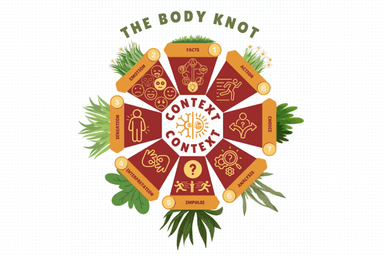
The Bodyknot: A Comprehensive Guide to Communication, Therapy and Personal Growth
“The Bodyknot” is a Bodynamic-based, nine-element framework for “untying” misunderstandings and stuck patterns in communication by tracking experience from context/basic mood all the way to actions. It’s presented as a practical map for therapists as well as for managers and individuals who want clearer, more grounded conflict resolution and self-expression. The piece also highlights how different character structures tend to fixate on—or skip—specific stages, and it offers structured guidance and exercises to build more complete processing and relational clarity.
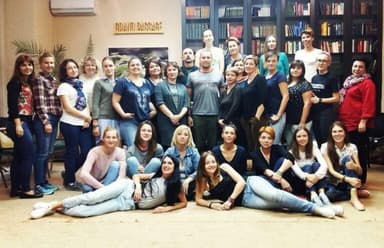
Reclaiming Wholeness: Ukrainian Veterans and the Somatic Revolution of Healing
Reclaiming Wholeness: Ukrainian Veterans and the Somatic Revolution of Healing By Hadi Bahlawan-Marcher, Kristina Vasiljevaite Marcher & Dominic Mathias Ukraine: When the Model Met the Moment In 2015, in response to a rising mental health crisis among Ukrainian veterans, Bodynamic partnered with Pobratymy and local leaders. Under the guidance of Ditte Marcher (a global expert in veteran trauma), four full training cohorts launched. This wasn’t therapy. It was co-education, a horizontal exchange and an invitation […]

Jedi
I stared to learn about Bodynamic when I was a child. My grandmother, Lisbeth developed the system and my mother was teaching it. A lot of the work was about how to heal after various types of trauma. I used the system and its methods and understanding a lot, consciously to make myself better in different areas. Unconsciously it was used by my parents and grandparents to heal my personal traumas as a child, as I had a serious health issue. I remember clearly how often Lisbeth would remind me to put focus on my center. I thought it was very irritating. She would often say: “sense your center, sense your center”.
Self-Support Manual & Exercises for Crisis work (in English & Ukrainian)
The process of returning to civilian life might begin with the decision to end the service or to go home – in case of a volunteer battalion. However, while the body returns home, our mind might take a long time to integrate the experiences of war and to learn how to live at peace with ourselves and people around us. This process is often complex and manifests itself as insomnia, impulsiveness, excessive aggression, loss of interest in the profession (or other familiar activities) that the person engaged in before the war, depression, and lack of enjoyment in life.
Building up Hope – Webinar
Bodynamic offered a free webinar on building up hope from within — how to stay hopeful in a concrete, realistic way rather than through magical thinking, and how taking responsibility for our own actions can turn powerlessness into strength.

DEVELOPMENTAL TRAUMA FROM A BODYNAMIC PERSPECTIVE
By Ditte Marcher and Lene Wisbom. In Bodynamic we differentiate between open and closed codings, developmental trauma, PTSD, and Complex PTSD — a distinction that shapes how we understand and work with trauma from a body-oriented perspective.

It Takes Courage to Stay in the Shy Moments
A man's joke falls flat at a party, and shame gets the better of him. From a Bodynamic perspective, shame and shyness aren't flaws to eliminate but functional signals of our drive toward dignity and mutual connection — and staying with them takes real courage.
Bodymap Testing & Interpretation
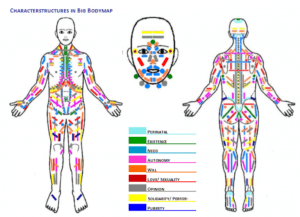
A central hypothesis in Bodynamic Analysis concerns the time period in which individual muscles come under voluntary control. There is observed to be a critical time period in which they acquire an imprint. This imprint is not simply about physical strength or kinesthetic ability. It concerns the psychological content or issue associated with the activity or function of this muscle. Thus the muscle encodes or “remembers” what happened in the emotional/ psychological environment in the time period in which it came under conscious control.