
The Body Was Never Meant to Hold That Much
When fear takes over and turns into terror, orientation collapses.
The body loses its sense of here and now.
Logic disappears — not because it is weak, but because the body no longer has enough support to hold reality.
This is panic.
And in that moment, nothing inside us is wrong.
Something inside us is overwhelmed.
A panic attack is not a weakness of character or a failure of will.
It is what happens when the body is pushed beyond what it can hold — when the inner compass loses north, and the body is left alone to protect itself.
Anxiety and Panic: Not the Same
In this perspective, anxiety and panic are closely related, but not the same.
Anxiety is pressure.
The body is still holding, still organising, still trying to cope.
Orientation is strained, containment is tight, and control strategies are active.
Panic is collapse.
The pressure has exceeded the body’s capacity.
Orientation breaks down, containment fails, and the body is no longer organising experience — it is fighting to survive it.
Most people move back and forth along this continuum.
Anxiety often precedes panic, and panic often leaves the body in a state of chronic anxiety.
The Loop
Many people live inside this movement every day.
Not once in a while — but many times a day.
They are caught in a relentless loop of anxiety, panic, terror, and exhaustion.
And often, what keeps the loop alive is the very thing they believe will save them: control.
We try to control the anxiety.
We try to stop the panic.
We try to think our way out.
We try to foresee what is coming.
We try to hold what cannot be held.
But control does not restore orientation.
Control does not create safety.
Control does not calm terror.
Control reaches forward into a future that cannot be predicted.
It tries to grasp what is already slipping.
It attempts to stabilise a body that has lost its ground.
And so the pressure increases.
Anxiety tightens.
And panic eventually takes over.
The Hidden Tragedy
This is the tragedy so many people live with:
The harder they try to stop the anxiety or control the panic, the more powerful it becomes.
Clients often arrive saying, “What’s wrong with me?”
But the more relevant question is rarely asked:
What is happening in and around me that my body no longer has the capacity to hold?
Because anxiety and panic do not arise in a vacuum.
The World the Body Lives In
We are living in a world that continuously overloads the body:
- constant acceleration without rhythm
- endless information without digestion
- emotional exposure without relational holding
- collapsing certainties
- pressure without pause
Our bodies evolved for rhythm, orientation, contact, boundaries, and meaning.
Instead, many people live in a state of chronic mobilisation with no place to land.
No wonder anxiety becomes constant.
No wonder pressure builds.
No wonder the body eventually collapses into panic.
A Different Understanding
People suffering from anxiety and panic are often labelled “difficult.”
But what we are actually meeting is a body that has been holding too much for too long.
They are not resisting help.
They are trying not to disintegrate.
So the task is not to teach more control.
It is not to eliminate anxiety.
And it is not to fight panic.
The Real Task
The task is to restore orientation.
To rebuild grounding.
To support containment.
To help the body land again.
Healing anxiety and panic is not about mastering fear.
It is about restoring the body’s capacity to stay present under pressure —
and to survive collapse without being lost in it.
It is about safety that is felt, not explained.
About contact that is regulating, not demanding.
About another human body that can remain oriented when the client cannot.
Where Hope Lives
And this is where hope lives.
Because anxiety is not a flaw.
Panic is not a defect.
Collapse is not a personal failure.
They are signals.
They are responses.
They are expressions of a body that was never meant to hold that much.
With the right support, the body can relearn:
- how to orient
- how to contain
- how to feel without being flooded
- how to land again
Not by force.
Not by control.
But by grounding, contact, and presence.
And in a world that is becoming harder and harder to orient in,
this may be one of the most important forms of healing we can offer.
Practical Information
Dates: May 14–17, 2026
Time: 10:00 – 17:00 CET
Lunch Break: 13:00 – 14:30 CET
Included: Short e-manual (PDF) on narcissistic and borderline dynamics in body-oriented therapy
Investment
- Super Early Bird: €449 Available until March 31 – 2026, or for the first 15 participants only (which ever comes first).
- Early Bird: €499 – Until April 1, 2026
- Full Price: €850 – After April, 2026
Registration
To register, please contact: Yorgos Piaditis at info@bodynamic.gr
Please note: Sessions will be recorded, and Bodynamic reserves the right to use recordings for future e-learning purposes.
Participants who attend the full workshop live will receive:
- a certificate for 2 hours of Bodynamic supervision credit
- 3 months of access to the workshop recordings after the training ends
Zoom Information
We have the latest equipment to provide a crystal-clear visual and audio experience using Zoom. Multiple camera angles and sensitive microphones contribute to an outstanding online training.
Our instructors are highly experienced in this method of teaching, having conducted Zoom workshops, trainings, and webinars since the beginning of the Corona pandemic in April 2020. For joining, please send an email to: info@bodynamic.gr
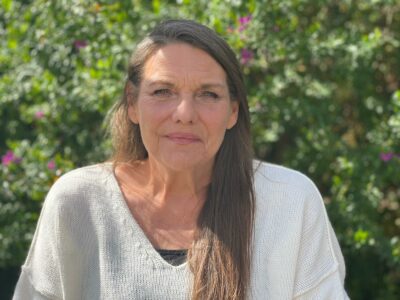
Meet Your Trainer: Ditte Marcher
Born in 1959, Ditte Marcher is the daughter of Bodynamic’s founder, Lisbeth Marcher, and has been an active member of Bodynamic International since 1994. She completed the full Analytic Training in 1995 and continued her path to become a certified Bodynamic teacher, therapist, and supervisor.
Ditte is one of the co-creators of Bodynamic’s Shock Approach and has deeply influenced the system with key concepts such as Dignity, the “Me”, and the different layers of feelings. Her work has shaped how Bodynamic integrates developmental psychology, attachment theory, and the body’s role in human resilience and connection.
Since 1995, Ditte has taught in Foundation Trainings, and since 2003, she has served as a senior teacher in Practitioner Trainings. Over the years, she has brought Bodynamic’s teachings to the US, Canada, Russia, Belarus, Ukraine, Japan, Greece, the Netherlands, Denmark, and Brazil. From 2008 to 2019, she also served as CEO of Bodynamic International.
Beyond her work as a teacher and therapist, Ditte has led a wide range of trainings, workshops, and consulting projects for professionals, organizations, and humanitarian teams. Between 1986–1992, she worked in war zones with children in crisis in Palestine, Lebanon, and Israel. From 1994–1998, she worked as a consultant for police departments in Denmark and Sweden, supporting interventions with at-risk youth, and trained AMU Center teachers in working with unemployed adults.
In 1999, Ditte facilitated workshops for police and fire departments in Seattle and Vancouver, focusing on communication during crisis situations. She has since contributed to conflict resolution and trauma support in regions across Africa, South America, and Europe, including the former Yugoslavia.
Ditte is co-author of the book “Resources in Coping with Shock” (with Merete Holm Brantbjerg) and the article “Psychophysical Approaches to Working with PTSD and the Ego” (with Lene Wisbom, 2014).
She has presented Bodynamic’s trauma approach at major international conferences, including:
- The European Trauma Conference in Edinburgh
- EABP Conferences in Athens (2004, 2016)
- The International Scientific Committee for Psycho-Corporal Psychotherapy, São Paulo (2005)
- The Conference for Shock and Trauma, Netherlands (2010)
- The Body Psychotherapy Conference, Krakow (2017)
Ditte has also given guest lectures at universities and colleges in the US, Greece, Canada, Poland, Brazil, and Ukraine, sharing Bodynamic’s integrative approach to trauma, development, and embodied psychology.