
Bodynamic Foundation Training 2027
Southern California
USA Pacific Coastal Time Zone
April 7–11, 2027
Jume 2–6, 2027
August 18–22, 2027
October 13–17, 2027

Childhood development is an amazing and complex process. Along with the normal physical milestones such as sitting, creeping, crawling and walking, the child undergoes several stages of psychological and emotional development – in effect transformation – that is driven primarily by the child’s desire to be in deep Mutual Connection with others and the world around it.
The Seven Developmental Stages are each named for the main emotional theme that is developed in the given time frame. Each stage is also defined by various developmental movements as muscles come under conscious control and are neurally mapped in the brain. Also delineated are various emotional and cognitive capacities which we term ego functions which develop at certain times.
The Seven Developmental Phases
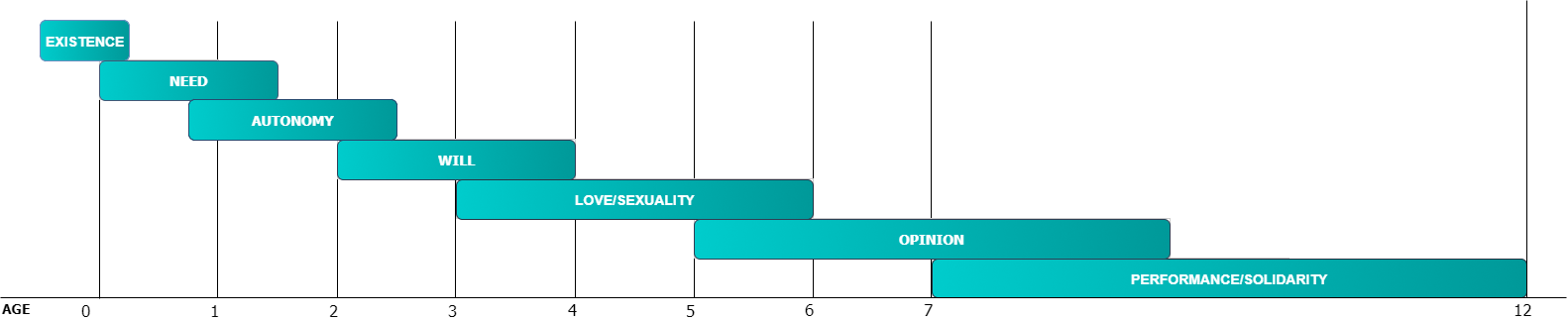
- Existence (2nd trimester → 3 months):
This stage focuses on the basic imprint of one’s right to exist and the sense of being alive, starting from the womb life to early infancy. Disruptions in this stage can lead to either withdrawal from connection or anxiousness about potential loss of connection. Key themes include sensations, emotions, contact, mirroring, and the distinction between the ‘Me’ and the ‘I’ (Ego).
- Need (1 month → 18 months):
This stage revolves around the infant’s experience of having their basic needs met in relation to their parents. Disruptions can lead to either a despairing or distrustful attitude about getting needs met. Key themes include establishing rhythms, mirroring, exploring in contact with others, and connecting words with emotions and needs.
- Autonomy (8 months → 2 years, 6 months):
Here, the child’s curiosity drives them to explore the world, marking their journey towards autonomy. Disruptions can lead to a lack of awareness of one’s impulses or a fear of commitment. Key themes include curiosity, distinguishing emotions, mastering activities, and learning to use the toilet.
- Will (2 → 4 years):
This stage is about the child’s ability to separate thinking, intentions, and actions, making choices, and putting power into action. Disruptions can result in either acting from a self-sacrificing position or holding back power. Key themes include choice and consequences, managing power, distinguishing between intention and action, and understanding dualities.
- Love/Sexuality(3 → 6 years):
This stage focuses on the child’s learning to love in a romantic way and integrating heart and sensual feelings. Disruptions can lead to a split between loving and sensual feelings. Key themes include awareness of one’s gender, integration of love and sensuality, and balancing loving, intimate, and sensual emotions in social contexts.
- Opinion (5 → 9 years):
The child learns to express themselves in words and deals with rules, norms, and culture. Disruptions can lead to difficulty in forming and expressing opinions or having rigid opinions. Key themes include understanding meanings of words, reality testing, forming own opinions, and using arguments.
- Performance/Solidarity (7 → 12 years):
Children in this stage seek to find their role within groups and the broader culture, often gravitating towards same-sex groups. They experiment with various roles, from leadership to mediation, while also striving to specialize in specific skills or hobbies. Disruptions in adulthood can lead to either a fear of competition or an overwhelming need to stand out in group settings.
Training Details
The Foundation Training – Discover the Power of the Bodynamic System
The 20-day Foundation Training, divided into four modules is a comprehensive introduction to the Bodynamic System—a pioneering approach that connects psychology, physiology, and human development.
This course explores character structures, positions, childhood developmental stages, and the interplay between body and behavior. You’ll also explore the fundamental concepts of communication, such as mutual connection, dignity, boundaries, centering, and grounding while sharpening your professional skills to cultivate greater presence and depth in your work.
What will the training cover?
This training delves into psychological and physiological development, focusing on character structure formation and its impact on the body. You’ll explore the origins of your preferences, biases, and defenses, understanding their benefits and challenges.
The training offers Bodynamic techniques that support behavioral change for all ages and refine your ability to analyze the physiological body in psychological terms. By developing this skill set, you’ll gain fresh perspectives on engaging with others effectively and choosing actions that foster meaningful interactions.
Additionally, you’ll learn the short version of the Bodyknot technique—a practical tool for maintaining dignity and mutual connection in difficult situations. This approach aids conflict resolution and strengthens the observing ego, promoting self-awareness and relational harmony.
Why should I take Bodynamic training?
The Bodynamic System, with over 40 years of research and development, is a Somatic Developmental Psychology system—a groundbreaking paradigm of empirically researched psychology with a focus on practical application. What truly makes this system unique is its distinctive ability to make psychological processes measurable.
With a global reach, Bodynamic International offers comprehensive training programs, empowering individuals and professionals worldwide to deepen their understanding of embodiment, self-awareness, and interpersonal dynamics.
Who is this training for?
| Therapists | Naturopaths | Pedagogues |
| Physiotherapists | Massage Therapists | Trainers |
| Doctors | Dance Teachers | Teachers |
| Psychiatrists | Yoga teachers | Salespeople |
| Osteopaths | Social workers | Parents |
| Cranio-sacral specialists | Mental Health Counsellors |
Foundation Training Outline
Training Venue: Southern California (details will be shared later)
4 x 5 Day modules = 20 Days Total
Classes run from 10 am – 6 pm PST every day (1.5hr Lunch break)
Module 1: April 7–11, 2027
- Bodynamic System overview
- Bodyknot
- Layers of Feelings
- Ego Aspects
- Existence Developmental Phase


Module 2: June 2–6, 2027
- Need Developmental Phase
- Autonomy Developmental Phase
Module 3: August 18–22, 2027
- Will Developmental Phase
- Love/Sexuality Developmental Phase


Module 4: October 13–17, 2027
- Opinion Developmental Phase
- Performance/Solidarity Developmental Phase
Registration Details
Payment Options:
- $4,500 Super Early Bird (pay in full by July 31, 2026)
- $5,000 Early Bird (pay in full by October 31, 2026)
- $5,500 Full Price (pay in full by January, 2027)
Payments can be made either in full or in installments, provided the full amount is received by the respective deadline.
Special discount opportunities may be available for school teachers, school counselors, undergraduate and graduate students funding their own tuition, and for groups of three or more participants from the same organization. Please contact me directly to discuss eligibility and details.
Registration: To join this training please contact Shiital Mehta at connect@sowilosoul.com You will receive an Intake Form and a Standards and Practices Form, along with payment details. Kindly review, complete, and sign these documents. Once you return the completed forms, Shiital will confirm your eligibility to proceed with the payment process.
Instructor Bios:

James Nicholas
James Nicholas is a certified Bodynamic® therapist and Bodynamic® analyst serving Southern California and is one of the North American training coordinators for Bodynamic® International. He is an attorney and member in good standing of the California Bar and an associate clinical social worker licensed in California. He received his B.A. in philosophy and history from UCLA, J.D. from Northwestern University, and M.S.W. from USC.
James has a background in massage therapy, Chua Ka, Tai Chi, cranial-sacral techniques, and bodywork. His focus areas include individual therapy, trauma, attachment, couples counseling, mediation/conflict resolution, and family systems. He also specializes in bodymapping (conducting and reading). In addition to private practice, James works as an associate clinician at the USC Center for Work and Family Life. He lives in San Diego with his wife and 7-year-old son.

Prahlad Ilex Galbiati
Prahlad is a body psychotherapist, trauma and dissociation specialist and a biodynamic craniosacral therapist with a passion for nature and spirituality.
With extensive experience working one to one and groups, in residential programs and outpatients’ settings, he has dedicated his career to supporting individuals in their pursuit of dignity, belonging, and connection.
Prahlad is a certified Bodynamic Therapist, Supervisor, Bodymapper and faculty and has been working with people since 1997. Known for his warmth, compassion, and direct approach, he possesses a natural skill for attunement.
His journey into trauma resolution and a life of service was guided by the invaluable support of his teachers, therapist, and world-class mentors.
Prahlad’s curiosity and determination continue to drive him to learn and grow in the field of trauma, drawing wisdom from both professional experience and the school of life. In addition to his therapeutic practice, he teaches trauma skills to both clinicians and laypersons, sharing his expertise and insights.
Outside of his professional life, Prahlad enjoys long walks, running, cycling, gardening, DIY and outdoor living. He cherishes the company of good friends and finds joy in the simple pleasures of life.