Ego Functions
The 11 Ego Functions
Several decades of research have led Bodynamic Analysis to distinguish eleven categories of psychological function, which we call the Ego Functions. Each muscle in the body, and groups of related muscles, embody a highly specific psychological content that is associated with one Ego Function, and occasionally with more than one.
The responsiveness that the therapist observes by palpating a particular muscle offers information about the client's patterns of Ego Functions — and at the same time, information about the Character Structures and the respective stage of development in childhood. Combining those two layers of information offers valuable new cognitive understanding relevant to the therapeutic process, while working with the muscles in question — either by hand or through movement — helps bring to the surface the psychological content of the particular muscle, and a host of correspondences to specific Character Structures and Ego Functions.
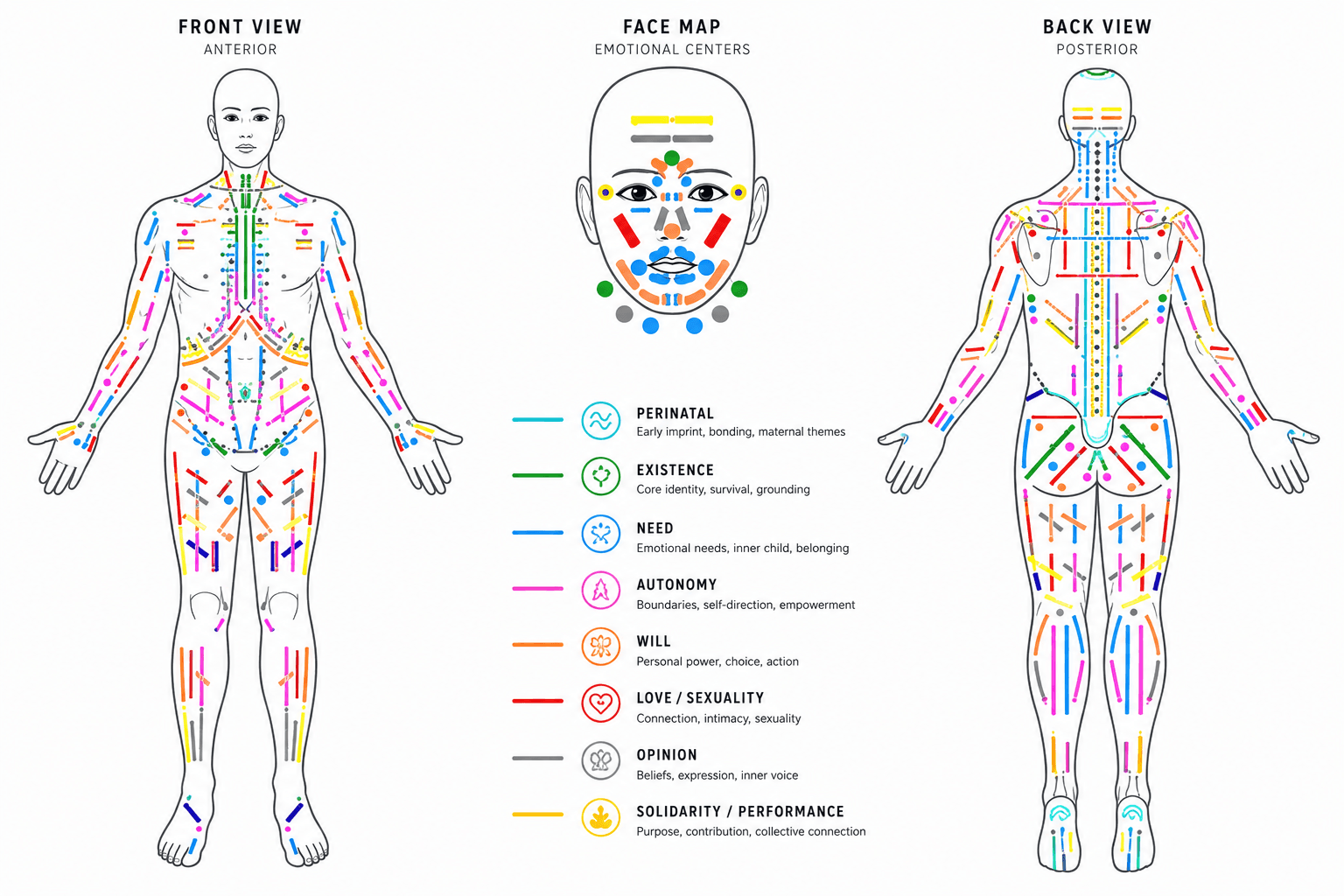
Figure 01 — The Bodymap
A chart of the body, drawn from fifteen thousand sessions.
Lisbeth Marcher and an interdisciplinary research group documented more than 15,000 session records across roughly 500 clients, alongside parallel observations of child development.
The instrument
Each muscle's elastic response is correlated with specific psychological content, and coloured by the developmental stage it belongs to.
Retested every couple of years, it offers a second lens on how a client is changing, alongside their own account of it.
The Eleven Ego Functions
- Connectedness — taking in, bonding, opening the heart; accepting support, feeling “backed up”, heart contact-opening.
- Positioning — existential position; stance towards life; poise for action, personal stance; standing on one's own; position on values and norms; orienting (keeping or losing one's head).
- Centering — filling out (from the inside); being oneself in one's different roles; feelings of self-worth.
- Boundaries — personal space (energetic boundaries); self-assertion (making space for oneself in social contact).
- Grounding & Reality Testing — ability to stand one's ground, feel rooted and supported by it; relationship to reality; relationship to spirituality.
- Energy Management — building charge, containment and discharge; emotional management; stress management; self-containment; perception and mastery of one's own sensuality.
- Social Balance — balancing one's own needs, feelings and desires against others' expectations; balance of pulling oneself together versus letting go; balance of facade versus openness in interactions; balancing being oneself with being a group member; balance of managing stress and resolving it.
- Cognitive Skills — orienting cognitive grasp; understanding (getting something well enough to stand forth with it); grasp of reality; ability to apply cognitive understanding to different situations; planning; contemplation and consideration.
- Self-Expression & Self-Assertion — assertion; asserting oneself in one's roles; forward impetus and sense of direction.
- Patterns of Interpersonal Contact — patterns of closeness and distancing; reaching out, gripping and holding on; drawing toward oneself and holding close; receiving and giving from one's core; pushing away (saying no) and holding at a distance; releasing, letting go.
- Gender & Gender Skills — awareness and experience of one's own gender and the appropriate gender role; capacity to contain and/or express one's sensuality and sexuality.
Example: The Ego Function of Centering
The Ego Function Centering concerns the human skill of being in contact with oneself and the degree of self-esteem or the valuing of one's own uniqueness. It is divided into four sub-functions, with body areas empirically connected to each:
- Awareness of one's own center — the deep muscles of the pelvis which connect the thigh and the lower back (psoas major, iliacus).
- Filling out from the inside — some smaller muscles which are close to the pelvic floor (gemelli, obturator internus), and the buttocks (sacrotuberous ligament, piriformis, gemelli, quadratus femoris).
- Being oneself in one's different roles — a flat muscle between the shoulder blades which pulls these together (rhomboids).
- Feelings of self-esteem — the sacrum, and the chest muscles (pectoralis major and minor).
Through training the sensing of one's center, a client's ability to sense what they like, dislike, want and need is increased. It is possible to work with a client's centering by having them take an interest in sensing the pelvic floor (rotating the thighs slightly outwards, pulling the lower part of the stomach in), the deep muscle of the pelvis (psoas), and the deep muscle of the lower back (quadratus lumborum) — the bodily container in the lower part of the torso.
More experiential and visual ways of working can also be used, such as asking how it feels in the center of the pelvis, whether there are colours, or what forms or shapes are present. Many people take pleasure in sensing a centering close to the spinal column, more like a center-line running vertically than a single point in the pelvis. To connect an inner experience of centering to a more outgoing energy — more centered around the roles a person holds in the world — the muscles between the shoulder blades and the large chest muscles are obvious areas to direct questions and movement exercises toward.