Bodymap
An exceptionally precise tool for psychological assessment and psychotherapy
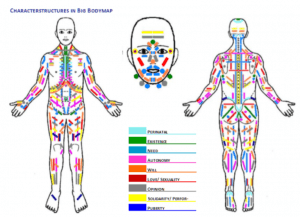
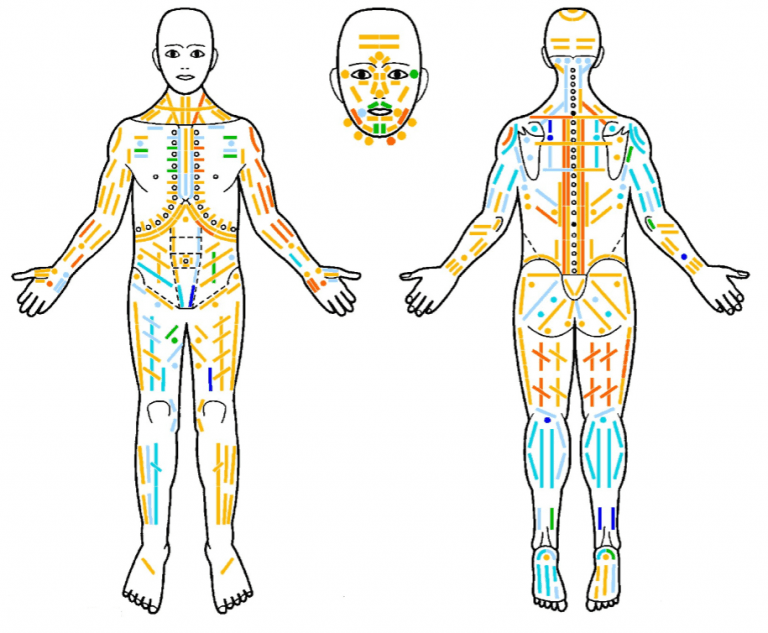
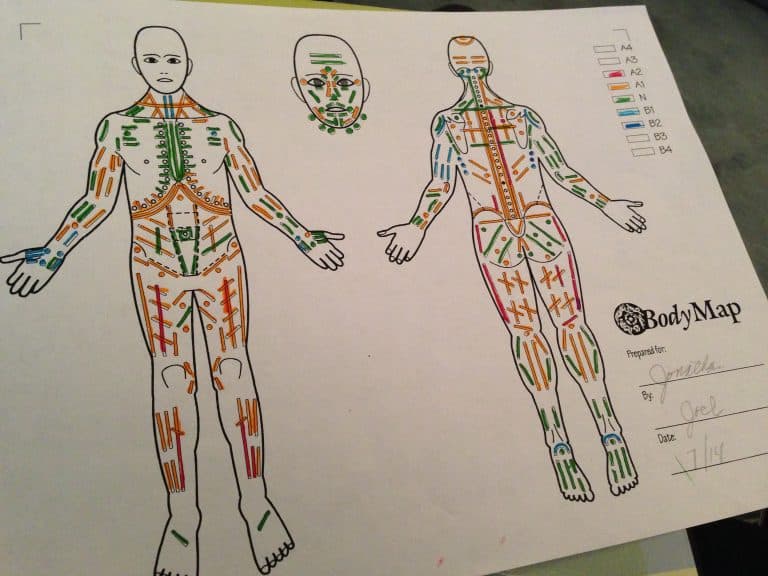
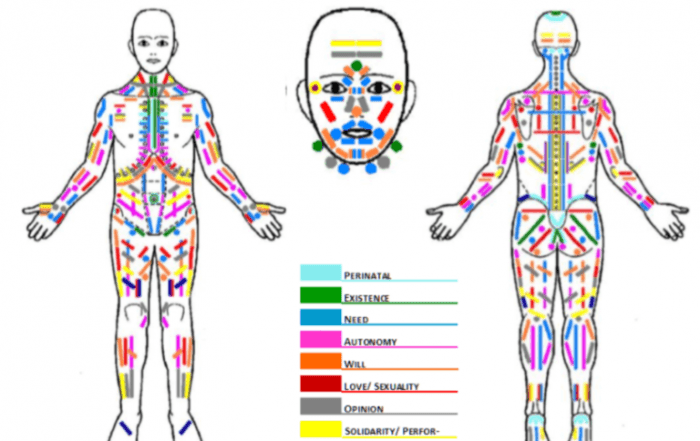
The ultimate working tool in the Bodynamic System is the Bodymap, an elaborate and precise chart of both resources and blockages in the client's body, mapped in terms of patterns of elastic response in the muscles and fasciae, and correlated precisely with psychological content. Based on palpation of over 125 muscles (and/or pairs of muscles), the Bodymap is used as a comprehensive aid for evaluating the client's personality, and offers a unique overall picture of childhood development, Character Structure, and the Ego Functions considered in Bodynamic Analysis. The Bodymap also helps the therapist project how the client might benefit from different kinds of therapy.
As Bodynamic Analysis evolved, in the early 1970s Lisbeth Marcher and her close team of associates produced and processed approximately 10,000 reports with specific sets of data from therapy sessions involving adults, alongside parallel observations of child development. This work was later refined against the practical experience of all senior members of the Danish Institute, and this basic empirical research forms the foundation of the Bodymap model.
The Bodymap was created in response to those mountains of primary data, both as an overall method and individually for every client. It allows psychology and physiology data concerning each individual client to be organized on a single chart that includes a front view of the human body, a back view, and a face-on view of the head. The map illustrates over 125 “testing points” on each side of the body (left-right) and uses nine different colours, mostly on the scales of red and blue, to illustrate the qualitative aspects of response of individual muscles, parts of muscles and fasciae, and the corresponding psychological content. Using this test, it is possible to pinpoint the age at which psychological problems have their roots, and to identify Shock Trauma and Post-Traumatic Stress Disorder.
“We map patterns of restrained, collapsed, and healthy impulses occurring at each developmental age level and assist clients build a new sense at the deepest layers of their beings” — Lisbeth Marcher, founder of Bodynamic Analysis.
Validating the Bodymap Against the Rorschach Test
The Bodymap also serves as a very accurate personality test particular to the Bodynamic System. A pilot study at one of the trauma clinics connected to a research hospital in Denmark compared the results of four different tests and methods commonly used for psychological evaluation of psychiatric and psychotherapy patients against the results obtained using the Bodymap — including the Rorschach projective test. The study found:
- The assessments obtained from the Rorschach and from the Bodymap showed a high degree of compatibility, greater than any other two assessment methods.
- The Rorschach was more accurate than the Bodymap in assessing cognitive development and associative processes.
- The Bodymap offered more precise and detailed information than the Rorschach about the client's development, the age when each of their problems arose, and precise information for identifying Shock Trauma.
- Overall, the Rorschach and the Bodymap were the two most reliable assessment methods, as confirmed by assessment of the same patients over the course of therapy.
The Bodymap in the Psychotherapy Process
At first sight the Bodymap appears complicated — today, a detailed analysis of an individual Bodymap is performed by computer, using specialized software that organizes the responses of hundreds of individual muscles in terms of Character Structures, Ego Functions, Shock Trauma/PTSD, and several other factors. A Bodynamic analyst can use a client's Bodymap as a constant reference offering invaluable information at every stage of the psychotherapy process — pinpointing the developmental age-stage in which a psychological problem has its roots, identifying Shock Trauma and PTSD, and correlating these to age and behavioural traits, to help formulate more educated hypotheses that direct the process.
The Bodymap offers a uniquely accurate method for psychological evaluation, since it applies a client-neutral instrument to review how clients are changing, rather than relying on the client's own verbal description of their experience of change. Bodymap testing every two years, on average, reveals very precise information about the actual progress of psychotherapy.
It is important to note that gaining this precise knowledge requires a large part of Bodynamic training to be devoted to learning the precise anatomical movements of the muscles in the body — an area where practitioners depend on anatomical atlases, manuals, and books used by other professional systems such as medicine and physiotherapy, supplemented by Bodynamic's own literature.