For clients
Find a Bodynamic therapist
Bodynamic therapists work in private practice in more than a dozen countries. The directory is maintained by the Association of Bodynamic Psychology, and you can search it by country.
Opens bodynamic.org, the Association's site
What the work involves
Bodynamic therapy is a body-oriented, developmental form of psychotherapy. A few things tend to make the experience distinctive.
- Body awareness, not just talk
- You don't only talk about the problem — you explore what happens in your body while talking about it. The therapist may notice posture, breathing, movement, muscular tension or collapse, while helping you notice your own sensations and emotional responses.
- Movement and muscles are part of the work
- Bodynamic links particular muscles and movement patterns with psychological capacities such as boundaries, grounding, centering, connectedness, self-assertion, and managing emotional intensity. A session might include experimenting with pushing, reaching, standing differently, sensing your feet, or activating a particular muscle and noticing what changes psychologically.
- Resource-oriented
- Rather than simply uncovering what went wrong, the therapist looks for capacities that may not have fully developed — or that became inhibited — and helps you experience and strengthen those capacities in the present.
- Development, in mind and body
- Bodynamic's Character Structure model looks at how experiences during different developmental periods can become reflected in adult relationships, emotions, behavior, and bodily patterns.
- Collaborative and concrete
- You typically agree on what you want to work with, explore it verbally and bodily, experiment with new embodied possibilities, and then integrate what you discovered so it can become useful in everyday life.
What a session feels like
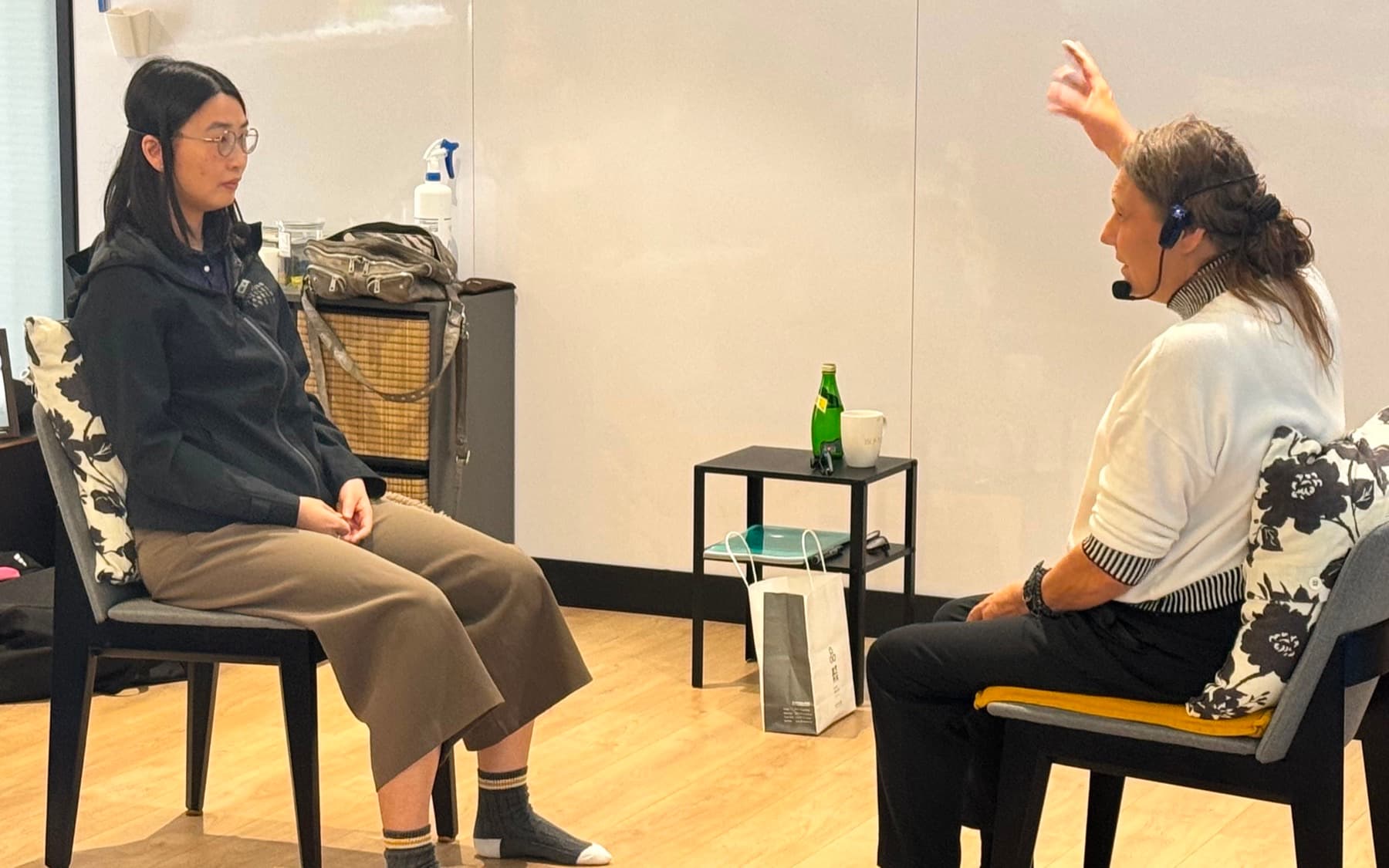
It can feel like a conversation interwoven with moments of slowing down and noticing your body: “What do you feel? Where do you sense that? What happens if you make this movement?” Instead of only understanding a pattern intellectually, you get opportunities to feel and practice a different way of being in your body, your emotions, and your relationships.
How Bodynamic therapists are certified
Certification is not a weekend course, and the designations are not interchangeable.
A practitioner first completes the Foundation Training, which is a prerequisite, and then the Practitioner Certification — three years and fifteen modules. The Practitioner Training has been qualified in Denmark through Reflektor, which evaluates professional standards across the public and private health sector.
From there, training splits into three designations, each building on the last. The distinction matters — it reflects real differences in hours of supervision and personal therapy, and in what you can expect from someone holding each title.
Each designation includes everything above it
- 01
Bodynamic Practitioner
Completed the Foundation and Practitioner trainings.
- 02
Bodynamic Certified Therapist
Completed a practitioner thesis, required supervision, and personal therapy hours.
- 03
Bodynamic Analyst
Completed the Bodymap, Shock Trauma & Reorienting Birth training.
Supervisor designations
- Bodynamic Supervisor
- Has completed the supervisor training.
- Educational Bodynamic Supervisor
- Has completed the supervisor training and holds the Bodynamic Certified Therapist designation. Supervision hours with an Educational Bodynamic Supervisor count toward the Certified Therapist designation.
How Bodynamic compares
A high-level look at how Bodynamic sits alongside five other widely practiced modalities, across the dimensions that tend to matter most when choosing an approach.
- Core feature
- Partial / variant-dependent
- Not central
| Dimension | Bodynamic | SE | CBT | EMDR | IFS | DBT |
|---|---|---|---|---|---|---|
| Body-based / somatic methodology | Core feature | Core feature | Not central | Partial / variant-dependent | Partial / variant-dependent | Partial / variant-dependent |
| Developmental character structure model | Core feature | Not central | Not central | Not central | Not central | Not central |
| Precise muscle–psychology mapping | Core feature | Not central | Not central | Not central | Not central | Not central |
| Ego function framework | Core feature | Not central | Not central | Not central | Not central | Not central |
| Reflex-level patterning & integration | Core feature | Partial / variant-dependent | Not central | Not central | Not central | Not central |
| Shock trauma resolution protocols | Core feature | Core feature | Partial / variant-dependent | Core feature | Partial / variant-dependent | Partial / variant-dependent |
| Resourcing before trauma processing | Core feature | Core feature | Partial / variant-dependent | Core feature | Core feature | Core feature |
| Cognitive restructuring / thought work | Partial / variant-dependent | Not central | Core feature | Partial / variant-dependent | Not central | Core feature |
| Attachment & co-regulation focus | Core feature | Partial / variant-dependent | Not central | Partial / variant-dependent | Partial / variant-dependent | Partial / variant-dependent |
| Structured skills training | Core feature | Not central | Core feature | Not central | Not central | Core feature |
| Group & team formats | Core feature | Partial / variant-dependent | Core feature | Partial / variant-dependent | Partial / variant-dependent | Core feature |
| Coaching & peak performance scope | Core feature | Partial / variant-dependent | Partial / variant-dependent | Not central | Not central | Not central |
Swipe to see all six
SE: Somatic Experiencing · CBT: Cognitive Behavioral Therapy · EMDR: Eye Movement Desensitization and Reprocessing · IFS: Internal Family Systems · DBT: Dialectical Behavior Therapy. A high-level comparison, not a claim of clinical equivalence — every modality here has variants and practitioner-to-practitioner differences a single row can't capture.
The directory
Search by country, and write to someone.
The directory is hosted by the Association of Bodynamic Psychology — a separate organisation from Bodynamic International, with its own site. Listings carry the designations described above.
Search the directory