Therapeutic Methods
Where theory meets practice
A trained Bodynamic therapist has many tools to draw on to adapt to various situations and clients. The following are some of the most important aspects of conducting Bodynamic therapy.
Therapy Session Path
A typical Bodynamic therapy session follows a general arc: forming a contract, conducting the therapy itself, and closing with integration.
- Form a contract — agree on an issue, get examples of how it affects present life, and make the contract clear, precise, inclusive, and doable. Identify the likely character structure and/or ego functions at play by tracking verbal and non-verbal cues.
- Conduct therapy — explore and work with the emotions and defenses related to the issue, using the Bodyknot, conflict resolution, physical touch/contact/support where appropriate, and developmental, energy, or endarkenment exercises. Affirmational Relational Messages (ARMs) are used as challenges are faced and new abilities are learned, connecting current issues with childhood experiences and strategies, and focusing on resources — what the client needs to move forward, and what they need to learn.
- Integration (Meta Analysis) — review the initial contract, the emotions that came up, the exercises that were tried, and affirm any new resources learned. Homework may be recommended. This review helps integrate new experiences into the adult ego.
1. Make a Contract
A contract is a type of agreement or plan for what the session aims to accomplish. It helps provide direction and focus. Ideally, forming a contract takes about 5 minutes — though in cases with severe autonomy issues at play, it could in the worst case take months to establish.
A contract, by its stated goal, will most of the time confine the session to a single character structure. In a smaller set of cases the session may move between two or three character structures, and if the issue is rooted in the teenage character structure, the therapist may need to work across all seven. Complexity increases the more character structures are involved, and the corresponding skill level required increases in tandem. It is typical for a hyper/late character structure to compensate for and mask issues in a hypo/early character structure, which can quickly shift the focus of a session as the underlying issue is brought to light.
Already at this early step the therapist is tracking the client, observing verbal and non-verbal cues, and helping the client through clarifying questions to arrive at a clear, concise and precise contract. Most often the character structure theme is the easiest to identify, and the therapist should have a good idea of which ego-function-based exercises may be useful. Ideally the contract applies to a current, precise situation in life — for example, “I would like to reduce anxiety when speaking my opinion about politics to my friend Jane” is a clear contract, whereas “I would like to reduce my anxiety” is not.
2. Conduct Therapy
For therapists in training, it is typically best to follow a linear approach to structuring a session — the initial contract helps create a developmental container for the work. The Bodynamic approach is generally more structured than a purely process-oriented approach, aiming to contain the process within a structure. Sometimes the process is not linear and logical but emergent, before returning to a more linear model. When many defenses are at play, or when working with the teenage structure, some exploration may be needed to uncover the underlying issue before a plan can be put in place.
3. Meta Analysis
The purpose of meta analysis is integration. This is especially important when working with the earlier character structures, since much of the work happens at the non-verbal Body Ego level — bringing in the Observing/Integrating Ego allows earlier experiences to be properly integrated with the adult ego, bringing maturity into the developmental process. Childhood immaturity and early defenses can have a powerful, subconscious pull that helps avoid responsibility and accountability, so bringing the child-self into the adult-self and integrating the two is of crucial importance.
Tracking
Tracking is perhaps the most important skill a Bodynamic therapist can learn — most Bodynamic theoretical and experiential training revolves around building this skill. Knowing what you are perceiving, and what it means for the client, determines what course of action is best to try next. Tracking includes both verbal cues (content of statements, voice intonation, energy and intensity) and non-verbal cues (collapsed or tensed muscles, movements of the arms and legs, spatial energetic emanation, facial expressions, and expressions in the eyes and mouth).
A Bodynamic therapist tracks these cues to ascertain two key elements: which character structure or structures are primarily at play with the presenting problem, and which ego function or functions are primarily at play. Secondary questions include which Ego Aspect is involved (Body, Individual, Role, Observing, or Integrating Ego), and whether there are trans-marginal elements present. Identifying the Character Structure gives the therapist the emotional theme of the issue and a powerful point of mutual connection; determining the Ego Function gives precise, practical information for working directly with the client by activating a specific part of the body. With both pieces of information, a muscle or fascia can be identified and a matching exercise chosen.
Some example verbal and non-verbal cues used in tracking: a client saying “I always get the wrong thing” may point to a Need issue (Distrusting); collapsed shoulders leaning forward may point to a Will issue (Self-Sacrificing); a client saying “I feel overwhelmed” may point to an Energy Management issue; feet not on the ground may point to a Grounding issue. On the trauma side, a client describing being left to cry alone as an infant may point to Developmental Trauma, while describing a rape, accident, or near-death experience points toward Shock Trauma (PTSD), and prolonged experiences like being a prisoner of war point toward Complex PTSD.
Tracking first needs to be learned consciously. With practice, a therapist builds the competency to identify character structures and ego functions without consciously thinking about it, eventually entering a flow state where the therapeutic practice becomes emergent rather than directed — freeing the therapist's attention to focus on emotional resonance and attunement rather than mental analysis. Perhaps one of the greatest challenges is forming a skill of dual awareness, tracking both oneself and the client simultaneously at somatic and emotional levels, while remaining centered, grounded, and clear of negative transference or counter-transference. The therapist also needs to be secure in themselves regarding the issue at hand, to provide a safe anchor point as the client moves through vulnerable and uncertain territory.
Transference and Counter-Transference
Transference and counter-transference are important tools for healing old developmental patterns. According to Boadella and others before him, transference reflects the history of earlier psychological patterns held in the muscles, which then get projected onto the therapist, trainer, or group members. Years of experience teaching and training psychotherapists working in other, non-Bodynamic modalities have shown that the Character Structure model can be applied as a powerful tool for describing different patterns of transference and counter-transference, since it describes muscle response patterns in tandem with a person's patterns of contact, social interaction, and behaviour.
The Bodynamic therapist-trainer can work with transference patterns specifically in relation to character structure or developmental patterns, using specific exercises, healthy parent messages, contact patterns, psycho-motor work, and language. By establishing a new contact pattern in the transference — or resonance, as Boadella describes it — a new imprint is created and integrated into daily life.
Working with Defenses
It is important to first identify the type and function of a defense. Virtually all defenses are ultimately a defense against feeling something, and it is by going for the underlying feeling that transformative healing can occur, when the right support and somatic resources are brought in. Ascertaining the type and function of a defense can quickly help determine which character structure issue is at play, and what course of action may be best — many defenses are acted out unconsciously and become part of a person's character, which is why having a therapist spot them and connect them to their underlying purpose can be so valuable.
Defenses can be grouped by their protective function. Defenses against emotion include suppressing an emotion (Early or Late Will), distracting oneself with something else (Late Autonomy), denial (Late Existence or Early Love), and intellectualizing (Early Existence). Defenses against sensing the self, or hypo-response, include hanging out in the “Void” (Early Autonomy), merging with another (Early Need), and dissociating from one's own body (Early Existence, or trauma). Defenses against relationship with the other, or hyper-response, include being judgmental (Late Will), competing with the other (Late Performance/Solidarity), and distrusting the other (Late Need).
“You only change when you learn to love your defenses.” — Lisbeth Marcher
Unlike systems of psychotherapy that try to break down defenses or make them conscious so a person can “just change” their behavior, the Bodynamic approach is based on compassion. Developmentally, defenses served an important protective function to keep a person safe — they worked, and are part of how the person survived and got here. That safety needs to be acknowledged before a person is likely to give up relying on them. Defenses are not inherently bad; they serve a functional purpose, and using them consciously may be necessary at times, especially in difficult situations. Having compassion for the disavowed parts of the self can be the most difficult work, and when a therapist can offer that compassion initially, it provides a powerful, positive template — often leading to transformative healing, especially when combined with work that increases embodiment through activating and sensing specific muscles.
Working with Emotions
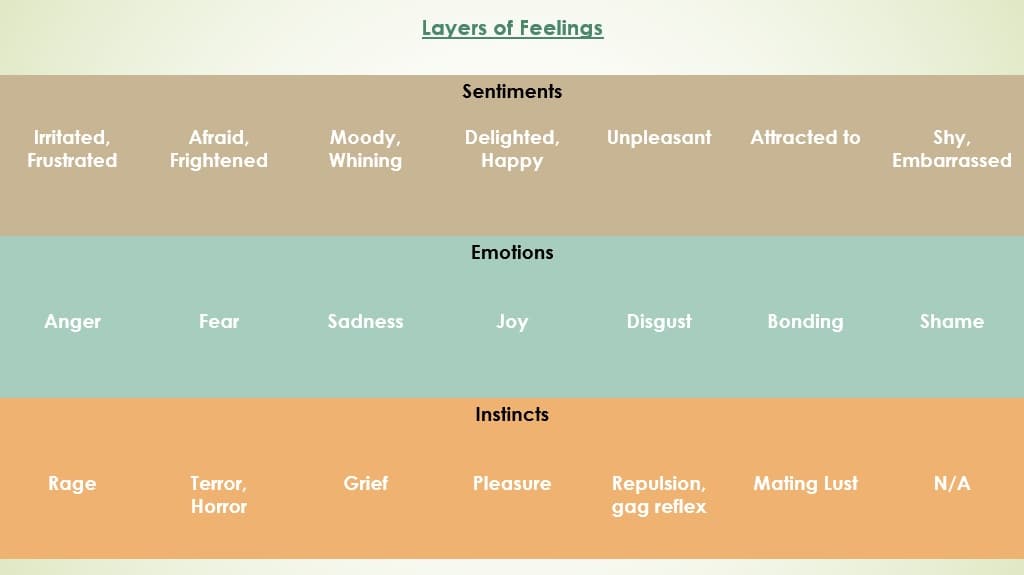
Here the aim is often to amplify repressed emotions, without regard to character structure or ego functions. Therapists train to match the intensity of the client's emotion through mirroring and resonance — looking for and supporting nascent expressions of emotion in the body, such as changing facial expression, shifts in eye expression, changes in breathing, tension in the jaw or throat, and changes in the tone, pattern and rhythm of speech. The therapist brings awareness to the emerging expression, gives space for the emotion, stays present with simple words and sounds of attuned support, and encourages taking time for full expression, often in waves.
This work creates the opportunity to express emotions long held back or given up, allows for a new body experience and a new experience of attuned relationship, and can free energy and vitality, promoting greater competency. The location of a feeling in the body can often give important cues as to which character structure or ego function is at stake. Repressive defenses often physically confine an emotion in order to manage it, so expanding the emotion — making more room for it — is a tactic often used to help process repressed emotion; activating muscles from the Containment and Connectedness (support) ego functions can greatly assist this process.
Affirmational Relational Messages (ARMs)
In Bodynamic, one of the ways we build a container inside of which we follow a client's process is by affirming our relationship with them — commonly through relating around the themes of the character structure and position they are expressing, and through Affirmational Relational Messages (ARMs), sometimes called good parent messages. A number of verbal, visual, and intuitive cues signal opportunities for sharing affirmative thoughts and feelings, including affirming a client's resources and abilities, hearing about their courage and risk-taking in the face of adversity, glimpsing a deep part of their authentic self, sensing their struggle or their need for support, feeling moved by their feelings and what they've faced, and noticing when they reach a new, transformative awareness or face a challenge in a productive new way.
We learn about who we are in relationship — if aspects of ourselves haven't been sufficiently mirrored and affirmed, it becomes difficult to really know ourselves. The acknowledgement and affirmation of unrealized abilities is one of the most powerfully transformative aspects of the Bodynamic process, which underscores the importance of tracking the client precisely enough for this to land well.
Exercises
Exercises are designed to build awareness and psychological resources in muscles and fascia — they are not raw strength exercises, and have nothing to do with a muscle's physical strength. Rather, they concern the psychological and emotional aspects of using a muscle in the context of a relationship with the self and with other people. When working with muscles, it matters whether a resource is blocked (hyper-tone) or missing (hypo-tone), since these call for different approaches — hypo muscles often need gentle physical touch, contact, or support to build awareness, while hyper-tone muscles may need to be stretched or engaged with resistance so the holding pattern can be sensed and allowed to relax.
Types of exercises include self-activation, activation with motion and subtle resistance from another, activation with contact or touch support from oneself or another, and stretching the muscle. A muscle or exercise can be chosen a few different ways depending on the contract and what emerges in the session — from an obvious character structure issue that leads through clarifying questions to an ego function and then a muscle, from an obvious ego function issue that leads to a character structure and then a muscle, or, for more complex issues such as trauma that span multiple character structures, by working directly with an ego function exercise without involving a specific character structure. Even with excellent tracking, a chosen exercise sometimes isn't the right fit — experimentation, trying different things until something lands, is key.
The Bodyknot
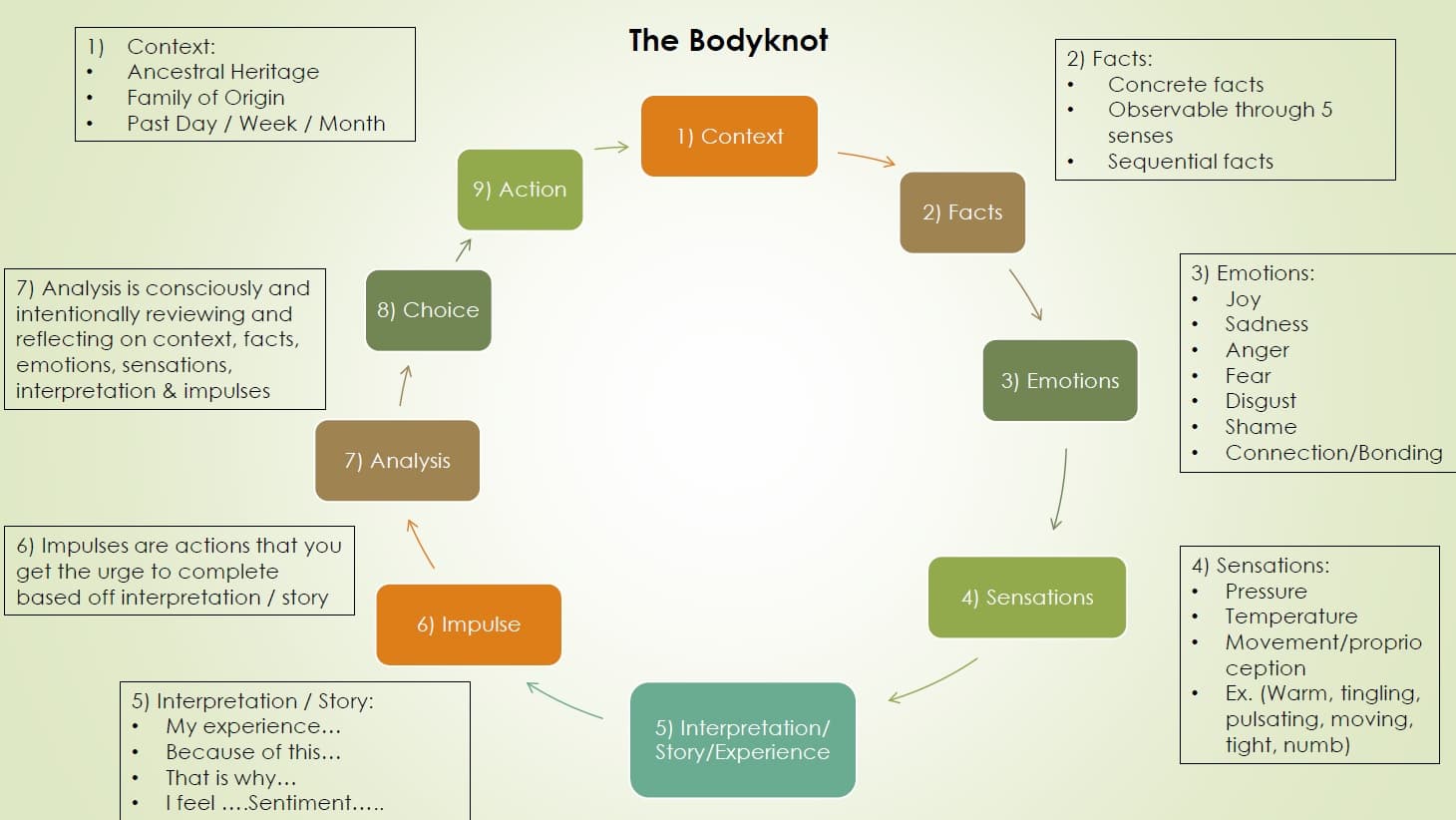
The Bodyknot is one of the core somatic tools in the Bodynamic therapeutic toolkit, used alongside conflict resolution work to help a client work through a specific issue in the moment.
Conflict Resolution
Whenever a person has a conflict with another, a simple fill-in-the-blank model can be used to break the conflict into its components, clarify feelings, and create a course of action toward resolution: “I want the contact between us to be changed. When you say/do [behavior], then I get [emotion], after that I act [defense mechanism], and I want this to change. I want you to [behavior]. I want me to [be concrete — how often, etc.]. Can you accept that? Will you be a part of that?” The other person then responds yes or no; if no, a new suggestion is proposed in the same form.
Other Therapeutic Principles and Methods
All major therapeutic modalities of the Bodynamic System — the Character Structures, Ego Functions, Shock Trauma/PTSD work, and the Bodymap — fully incorporate the body in the therapeutic process. The list of somatic-verbal tools used in therapy is long, and includes Active Sensing (evolved from Carl Rogers' Active Listening), Body Awareness (comprising Body Sensing, Body Experiencing, Body Emotions/Expression, and Body Regression — a theory and practice widely implemented in Danish education since the 1950s), Body Reading and Postural Mirroring, psychodynamic and boundaries exercises, guiding the client to sense and understand Reflexive Movement Patterns, unlocking impulses frozen in the body, and using resistance in movements and counter-movements to change patterns of body tension. Together, these somatic-verbal tools help the client develop new resources for action that are at once psychomotor and cognitive.
Using the Body to Support the Psychological Process
The body is a constant source of reliable information that can make an enormous difference in the psychological process. The Bodynamic System uses both supporting touch and activation of individual muscles, or groups of related muscles, to facilitate the unfolding of the psychological process. Informed by decades of precise research into the psychological function of individual muscles, this approach brings to the surface, simply and directly, the themes that need to be addressed so the psychological process can continue toward resolution.
As a session progresses, the therapist can physically monitor — visually and by touch — the quality of response in a muscle, confirming the actual improvement of the psychological process. For example, when working with a boundaries issue, a therapist may choose to touch the lateral deltoid muscle on one or both sides, activating that theme; meaningful progress on the actual boundary issue will inevitably be accompanied by a palpable change in the muscle's response, and by a change in body posture or attitude. To a trained practitioner, the quality of change in muscle response at any given moment can offer precise information about the current progress of the psychological process — information not available by any other means.
Active Sensing
A fundamental principle and therapeutic method of Bodynamic Analysis is Active Sensing. Many psychotherapy modalities base their understanding of the therapeutic process on the mental representations of the patient and/or therapist, which may or may not be relevant to the particular stage of the process. Bodynamic Analysis instead uses Active Sensing, a real-time skill for authentic and accurate understanding of actual body-mind events and conditions at every moment in therapy. Active Sensing offers a solid basis for interaction and builds grounded containment of emotions — it began with Carl Rogers' Active Listening, refined by adding precise knowledge of the body and questions and instructions related to the Bodyknot.