Ego Aspects
The 5 Ego Aspects
The entire graphic below is a picture of a personality, made up of several distinct Ego Aspects that develop at different points in life.
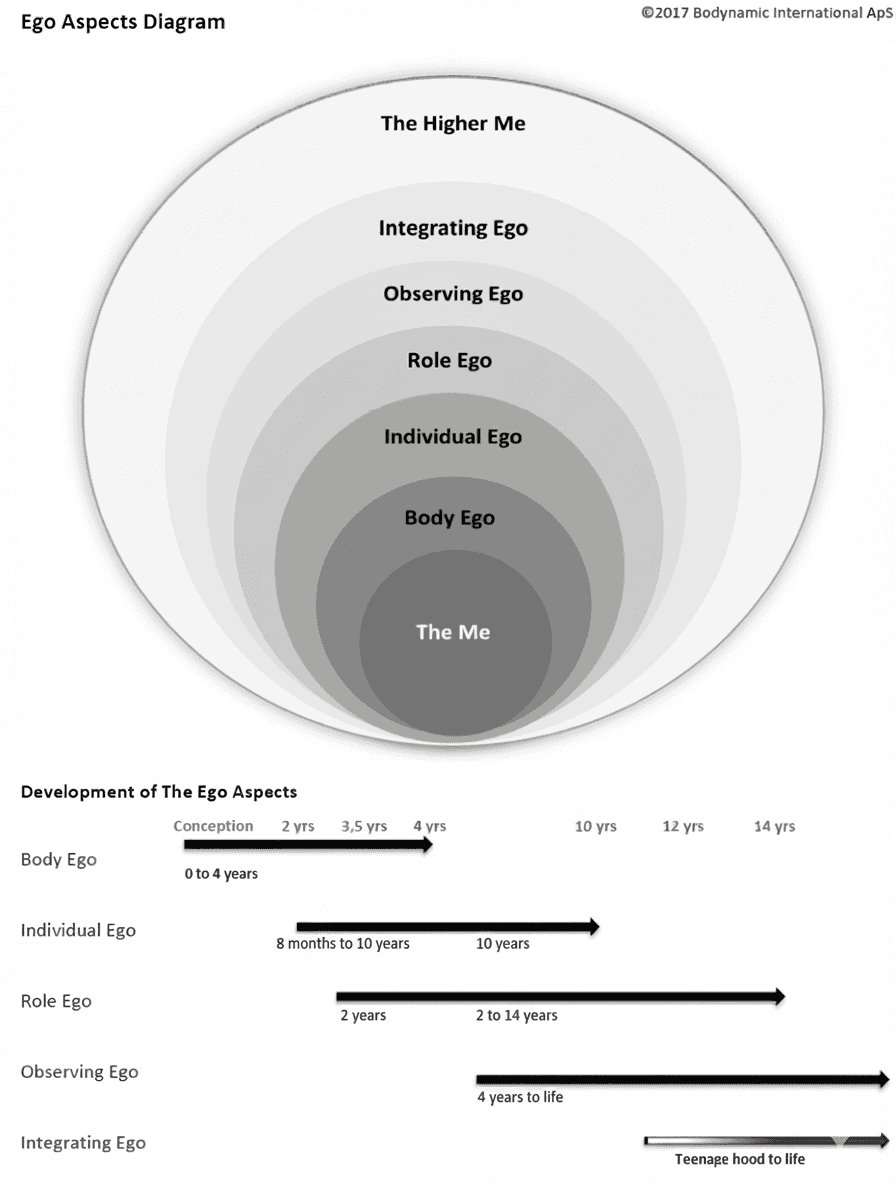
The Me
The Me has been there since conception, and the consciousness that envelops it can expand throughout our entire lives. The Me has faster unconscious strategies that go beyond the Ego's skills. The Me acts without delay from the cognitive consciousness — it includes the subjective, and all the bodily functions and mental processes that are not initiated or directed by the ego. When you have to respond quickly, or act so fast that there is no time to think about it, the Me steps in — it can act and make clear decisions without thinking.
The following knowledge is used by the Me: genetic knowledge, instinct, the reflex system, automatic skills (those skills trained repetitively and so frequently that they become automatic, like riding a bike), and the collective unconscious/spirituality. New knowledge is formed through any combination of at least two of these systems.
Body-Ego
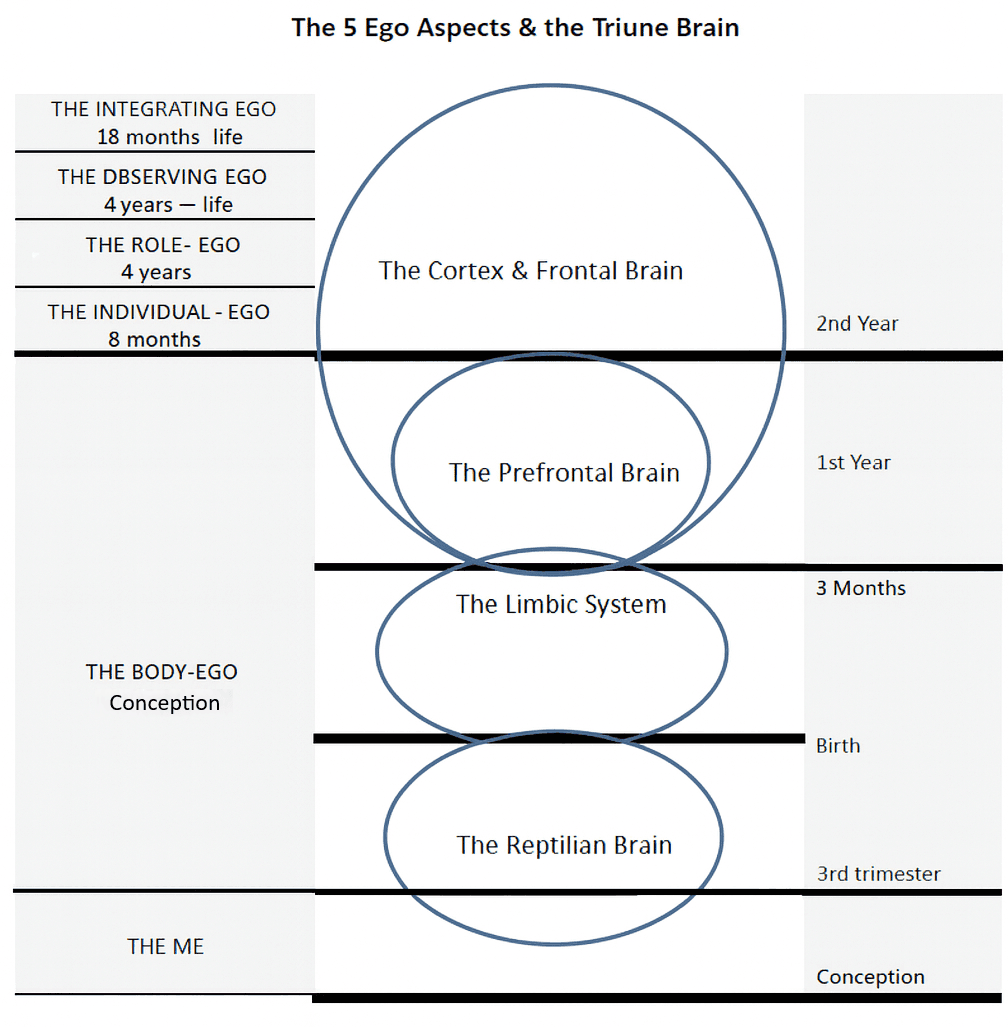
The Body-Ego develops since before birth, but in reality we perceive it through our physical senses and psychomotor sense perception.
The Individual Ego
The Individual Ego begins to form around eight months of age through the process of separation and individuation. At this stage, we start to become conscious of ourselves as distinct individuals — separate and different from others.
Role-Ego
The Role-Ego starts forming at 2 years of age, the point in time when we become able to experiment with roles in life and sustain them in our social interactions.
Observing Ego
The Observing Ego functions in conjunction with all three previous Ego Aspects, and refers to our ability to observe what we do while we do it.
The Integrating Ego
The Integrating Ego starts in adolescence and is the part of us that assimilates the four previous Egos into an adult awareness.
The Higher Self / Bigger Me
The Higher Self, or Bigger Me, is the part of the person that “takes over” when the Me cannot contain or act any more. Certain authors have described that process as “dissociation”, while others say the person “goes out of the body”. The important part is that this state of being offers new information from the collective unconscious, and from other levels of consciousness that are more spiritual.
Working with the Ego Aspects in Practice
If the problem is in the Individual Ego, you need to mix body and mind — keeping an eye on emotions, intentions and actions (including mimic, voice, role and movements), and observing how the other person is impacted, while at the same time sensing the body and verbalizing what is sensed.
If the problem is “only” in the Body Ego, the body is used to build a larger “animal foundation” in the Observing Ego — not only touching it physically, but making the client sense it. The child must sense the body and the emotions in the body at all times. This builds the foundation of the body, which then functions as a container for all emotions, energy build-up and impulses.
A person can never stop the development of the Ego Aspects. If a child has developed a healthy Body Ego over the first four years, it will continue to develop beyond that age. However, whatever happens after four years of age cannot disturb that foundation — the exception being a shock trauma, which is the only thing that can disturb an already-established foundation. The same holds true for the other Ego Aspects: they never stop developing, and if they are originally healthy, their fundamental resources can never be shattered except through a shock trauma.