
THE EMBODIED LEGACY OF TRAUMA
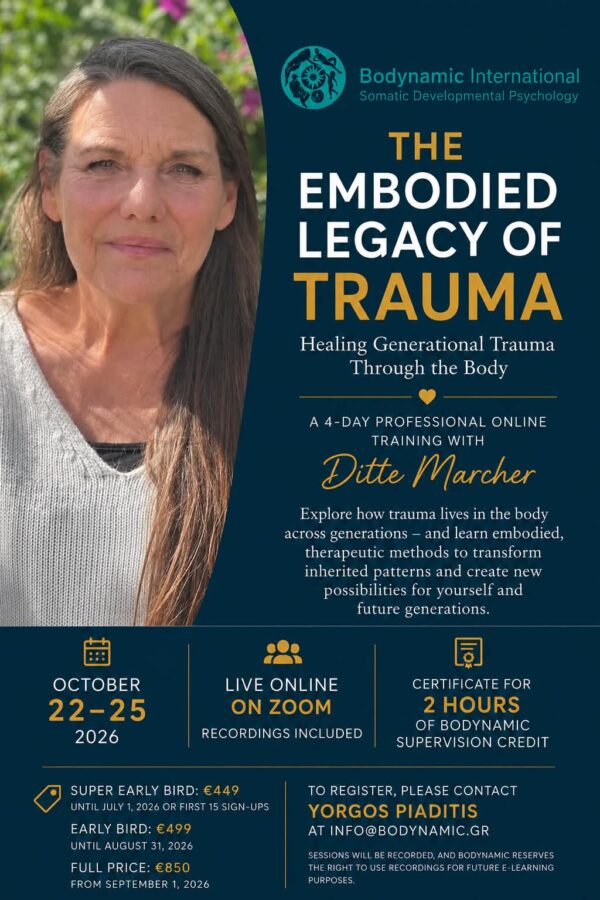
Healing Generational Trauma Through the Body
A 4-Day Professional Online Training with Ditte Marcher
The workshop takes place October 22–25, 2026.
Introduction
Some trauma belongs to our own life story.
Some trauma was already present before we were born.
Deep within our blueprint — within our DNA itself — begins the journey of generations.
The wisdom, pain, survival strategies, silence, fear, love, shame, and strength of those who came before us live not only in stories, but inside our muscles, fascia, nervous system, chemistry, emotions, posture, breath, and ways of relating.
From the very beginning of life, these inherited patterns shape how we meet the world.
How much of my fear is truly mine?
How much of my anger, shame, collapse, hypervigilance, or emotional overwhelm belongs to my own life experience — and how much has traveled silently through generations before reaching me?
These are the questions we will explore together.
This training invites participants into a profound embodied inquiry:
to begin separating what truly belongs to oneself from what has been carried unconsciously through family systems and ancestral survival patterns.
Through body awareness, nervous system regulation, relational work, and embodied therapeutic methods, participants will begin to discover new inner knowledge — learning to recognize inherited patterns, transform them, and create new possibilities for themselves and future generations.
Why Generational Trauma Matters
Inherited fear, silence, shame, emotional overwhelm, disconnection, hypervigilance, collapse, and survival strategies often move silently through generations — shaping the nervous system, relationships, identity, parenting, and our capacity for connection.
Many people carry wounds they cannot fully explain.
Many therapists work with clients who remain stuck despite years of insight and understanding.
Why?
Because trauma does not only live in memory.
It lives in the body.
In posture.
In breath.
In muscular tension and collapse.
In emotional regulation.
In attachment patterns.
In the nervous system itself.
And unless these embodied patterns are transformed, they often continue unconsciously from one generation to the next.
In the world we live in today — marked by increasing stress, burnout, anxiety, polarization, war, displacement, and collective overwhelm — the importance of understanding and interrupting these inherited trauma patterns has never been greater.
This immersive 4-day online training explores how generational trauma is held physically within the body and nervous system, and how therapists and helping professionals can work directly with embodied patterns to support healing, resilience, dignity, regulation, and mutual connection.
A Unique Bodynamic Approach
After decades of clinical work, international teaching, trauma intervention, and development within the Bodynamic System of Somatic Developmental Psychology, Ditte Marcher now offers one of her most comprehensive professional trainings on generational trauma and embodied healing.
This workshop represents the culmination of many years of therapeutic practice, trauma work, developmental psychology, body-oriented psychotherapy, and direct clinical experience working with inherited trauma patterns.
Participants are invited into a rare opportunity to learn from a mature, deeply embodied, and highly practical therapeutic approach developed through decades of real-world application.
The Bodynamic approach offers a uniquely precise understanding of how psychological experiences become embodied through:
- muscles
- posture
- breathing patterns
- movement
- boundaries
- emotional regulation
- relational dynamics
- and nervous system organization
Rather than approaching trauma only cognitively, Bodynamic works directly with how trauma is physically organized within the body and nervous system.
Through decades of research and clinical practice, the Bodynamic System has mapped the relationship between:
- psychomotor development
- muscle response patterns
- ego functions
- attachment
- emotional regulation
- body awareness
- trauma responses
- and personality development
This allows therapists to work with trauma in a way that is:
- embodied
- relational
- developmentally informed
- resource-oriented
- trauma-sensitive
- and immediately applicable in the therapy room.
The Bodynamic understanding of dignity, mutual connection, embodiment, and developmental psychology forms the foundation for this work.
Why This Training Matters Now
Therapists and helping professionals everywhere are increasingly meeting clients carrying:
- unresolved developmental trauma
- chronic stress activation
- emotional disconnection
- inherited survival strategies
- attachment wounds
- nervous system dysregulation
- and unresolved shock trauma
Traditional insight alone is often not enough.
Clients increasingly need approaches that include:
- the body
- the nervous system
- emotional regulation
- embodiment
- and relational repair
This training offers practical and deeply embodied methods for meeting these challenges.
Core Themes of the Training
Understanding Generational Trauma
- How trauma is transmitted across generations
- The impact of developmental trauma and shock trauma on identity and relationships
- Trauma, attachment, and nervous system regulation
- Survival strategies inherited through family systems
- The relationship between body organization and psychological patterns
The Bodynamic understanding of shock trauma emphasizes that traumatic experiences become deeply imprinted within body and nervous system organization.
The Body and Trauma
- How trauma is held physically in posture, breathing, muscles, movement, and emotional regulation
- Understanding embodied defense patterns
- Working with activation, collapse, overwhelm, dissociation, and shutdown
- Differentiating instinct, emotion, and feeling in trauma work
- Understanding the body’s survival intelligence
Bodynamic distinguishes between instinct, emotion, and feeling as separate layers of human experience, each involving different nervous system processes and therapeutic approaches.
Ego Functions and Resource Building
Participants will learn practical Bodynamic approaches for strengthening:
- grounding
- centering
- boundaries
- connectedness
- energy management
- body awareness
- containment
- dignity
- and self-regulation
These functions form essential foundations for trauma healing and therapeutic stabilization.
The Bodynamic system understands ego functions as embodied capacities rooted in muscular and developmental organization.
Working with Shock Trauma and PTSD
- Understanding shock trauma and PTSD from a Bodynamic perspective
- The relationship between developmental trauma and PTSD
- Creating safety and stabilization
- Supporting the Observing Ego and Body Ego
- Resource-oriented trauma work
- Working with safe space, safe people, and embodied regulation
- Supporting integration without retraumatization
The Bodynamic trauma model emphasizes the importance of stabilization, body ego strength, and the observing ego before direct trauma processing begins.
Practical Therapeutic Methods
Participants will experience and practice:
- body awareness methods
- grounding and centering exercises
- boundary exercises
- movement-based interventions
- containment and regulation techniques
- relational attunement
- embodied resource building
- trauma-sensitive therapeutic contact
- therapeutic use of body-oriented interventions in clinical work
This is not only a theoretical training.
Participants will receive practical tools and embodied methods that can immediately be integrated into therapeutic work.
Participants Will Leave With
- a deeper understanding of how trauma is transmitted across generations
- practical body-oriented tools for clinical work
- increased confidence working with trauma and nervous system dysregulation
- greater precision in recognizing embodied trauma patterns
- methods for supporting grounding, boundaries, regulation, and resilience
- practical interventions for helping clients move from survival into connection
- embodied exercises and therapeutic methods that can immediately be integrated into practice
- a deeper understanding of how dignity, attachment, and connection are restored through the body
This Training Is Relevant For
- Psychotherapists
- Body psychotherapists
- Psychologists
- Trauma therapists
- Counselors
- Coaches
- Social workers
- Somatic practitioners
- Healthcare professionals
- Educators and helping professionals
- Anyone professionally working with trauma, attachment, stress, and relational healing
About Ditte Marcher
Ditte Marcher is an international trainer and senior therapist within the Bodynamic System of Somatic Developmental Psychology, with decades of experience in trauma work, psychotherapy training, body-oriented therapeutic methods, and developmental psychology.
Her work integrates deep clinical experience with embodied therapeutic practice, combining body awareness, developmental understanding, trauma integration, attachment work, and nervous system regulation into a highly practical therapeutic approach.
Over many years, she has contributed to the development and refinement of Bodynamic approaches to trauma healing, PTSD, developmental trauma, embodied regulation, and resource-oriented psychotherapy.
Closing
Healing generational trauma is not only personal work.
It is relational, cultural, and collective work.
Every time a person restores connection with their body, emotions, dignity, boundaries, and capacity for mutual connection, the possibility for a different future emerges — for themselves, for their relationships, and for future generations.
When trauma is transformed through the body, new possibilities emerge — not only for individuals, but for families, relationships, and future generations.
Investment
Super Early Bird: €449
Available until July 1, 2026, or for the first 15 participants only — whichever comes first.
Early Bird: €499
Available until August 31, 2026.
Full Price: €850
From September 1, 2026 onward.
The workshop takes place October 22–25, 2026.
Registration
To register, please contact:
Yorgos Piaditis at info@bodynamic.gr
Please note: Sessions will be recorded, and Bodynamic reserves the right to use recordings for future e-learning purposes.
Participants who attend the full workshop live will receive:
- a certificate for 2 hours of Bodynamic supervision credit
- 3 months of access to the workshop recordings after the training ends
Zoom Information
We have the latest equipment to provide a crystal-clear visual and audio experience using Zoom. Multiple camera angles and sensitive microphones contribute to an outstanding online training.
Our instructors are highly experienced in this method of teaching, having conducted Zoom workshops, trainings, and webinars since the beginning of the Corona pandemic in April 2020.
For joining, please send an email to:
info@bodynamic.gr
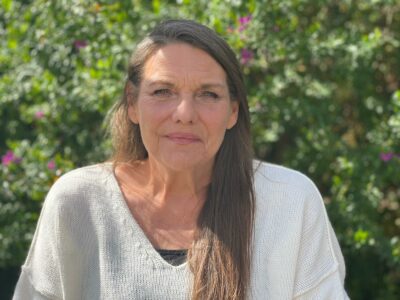
Meet Your Trainer: Ditte Marcher
Born in 1959, Ditte Marcher is the daughter of Bodynamic’s founder, Lisbeth Marcher, and has been an active member of Bodynamic International since 1994. She completed the full Analytic Training in 1995 and continued her path to become a certified Bodynamic teacher, therapist, and supervisor.
Ditte is one of the co-creators of Bodynamic’s Shock Approach and has deeply influenced the system with key concepts such as Dignity, the “Me”, and the different layers of feelings. Her work has shaped how Bodynamic integrates developmental psychology, attachment theory, and the body’s role in human resilience and connection.
Since 1995, Ditte has taught in Foundation Trainings, and since 2003, she has served as a senior teacher in Practitioner Trainings. Over the years, she has brought Bodynamic’s teachings to the US, Canada, Russia, Belarus, Ukraine, Japan, Greece, the Netherlands, Denmark, and Brazil. From 2008 to 2019, she also served as CEO of Bodynamic International.
Beyond her work as a teacher and therapist, Ditte has led a wide range of trainings, workshops, and consulting projects for professionals, organizations, and humanitarian teams. Between 1986–1992, she worked in war zones with children in crisis in Palestine, Lebanon, and Israel. From 1994–1998, she worked as a consultant for police departments in Denmark and Sweden, supporting interventions with at-risk youth, and trained AMU Center teachers in working with unemployed adults.
In 1999, Ditte facilitated workshops for police and fire departments in Seattle and Vancouver, focusing on communication during crisis situations. She has since contributed to conflict resolution and trauma support in regions across Africa, South America, and Europe, including the former Yugoslavia.
Ditte is co-author of the book “Resources in Coping with Shock” (with Merete Holm Brantbjerg) and the article “Psychophysical Approaches to Working with PTSD and the Ego” (with Lene Wisbom, 2014).
She has presented Bodynamic’s trauma approach at major international conferences, including:
- The European Trauma Conference in Edinburgh
- EABP Conferences in Athens (2004, 2016)
- The International Scientific Committee for Psycho-Corporal Psychotherapy, São Paulo (2005)
- The Conference for Shock and Trauma, Netherlands (2010)
- The Body Psychotherapy Conference, Krakow (2017)
Ditte has also given guest lectures at universities and colleges in the US, Greece, Canada, Poland, Brazil, and Ukraine, sharing Bodynamic’s integrative approach to trauma, development, and embodied psychology.